The driving skills test, which most people call the road test, is the last step before an Indiana driver’s license. It is short, and the examiner is not trying to trick you. Most people who fail do so for a handful of predictable reasons. This guide covers where to take the test, what to bring, how it is scored and what causes an automatic fail.
Two places to take the test
At a BMV branch
Tests at a branch are by appointment only. You book between 48 hours and three weeks ahead and arrive at least 15 minutes early. You bring your own vehicle, and a licensed driver has to come with you. If you are under 18, a parent or guardian must be there.
At a licensed driving school
Driving schools that take part in the BMV testing program can give the same official test. Elektra Driving Academy is one of them. You take the BMV road test at our location on East Washington Street, in one of our cars, at no additional fee for the car. You need a valid Indiana learner’s permit to test with a school.
What to bring
- Your valid Indiana learner’s permit.
- Your completed Log of Supervised Driving Practice.
- Proof that you completed driver education, if you took it.
If you test at a branch, the car is inspected just before the test. It must be registered and insured, with two working brake lights, four working turn signals, doors that open, a windshield with no cracks and no temporary spare tire on a wheel. If the car fails the inspection, the test is canceled. Driver assistance features such as automatic parking must be switched off.
What the examiner checks
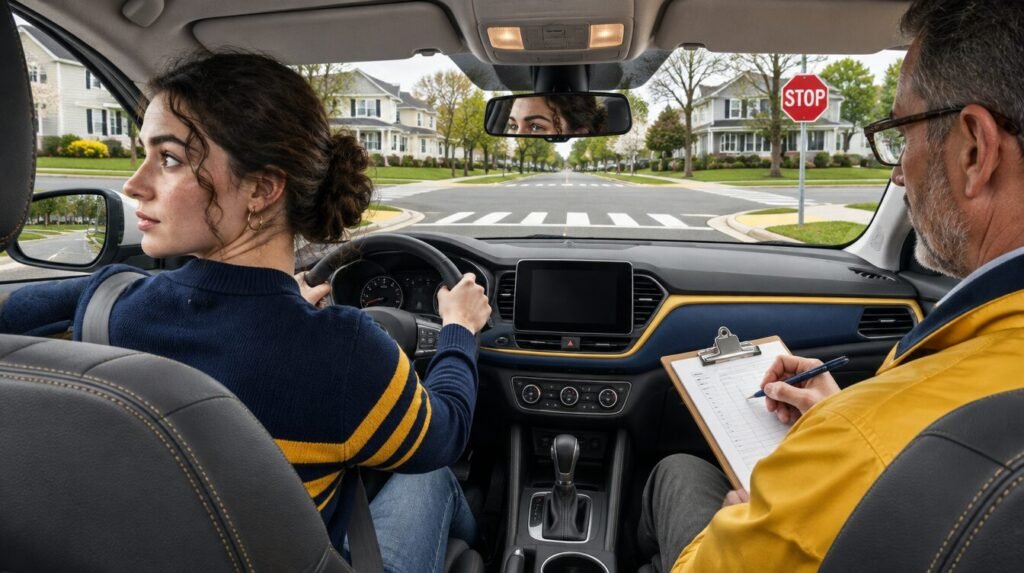
The test takes place in normal traffic with only you and the examiner in the car. The BMV lists these skills:
- Lane position. Staying in your lane, respecting lane markings and signaling before every lane change.
- Following distance. Leaving enough room behind the vehicle ahead.
- Speed. Matching the posted limit and the conditions, neither too fast nor too slow.
- Intersections. Approaching at the right speed, looking both ways, stopping completely and never racing a yellow light.
- Backing. Reversing out of a parking space slowly, using mirrors and checking blind spots.
- Parking. Checking traffic, signaling and entering the space smoothly.
Expect the classic maneuvers too: parallel parking, a three point turn and controlled stops.
Small mistakes that cost points
These do not fail you on their own, but they add up:
- Forgetting a turn signal, or leaving it on after a lane change.
- Taking a hand off the wheel when you do not need to.
- Not checking your blind spot.
- Stopping past the stop line or in the crosswalk.
- Driving too slowly or stopping for no reason.
- Following too closely, or passing too close to parked cars.
- Reversing too fast.
Mistakes that end the test
Some errors are an automatic fail, whatever the rest of your drive looked like:
- Not wearing your seat belt.
- Running a stop sign or a red light, or making a rolling stop.
- Speeding, including in a school zone.
- Ignoring a yield, school zone or no turn on red sign.
- Failing to yield the right of way.
- Turning into the wrong lane, straddling lanes or crossing a solid yellow line.
- Backing over a curb or touching a parked vehicle.
- Passing a school bus with its stop arm out.
- Not pulling over for an emergency vehicle.
- Driving too close to a pedestrian or a cyclist.
- Not following the examiner’s instructions, or causing a crash.
Notice how many of these are habits and not skills. Seat belt, full stops and speed are decided before you even leave the parking lot.
If you do not pass
You wait 7 days before the next attempt. After three failed tests, you wait two months from the date of the last one. Keep an eye on your permit: if it expires before you retest, you have to renew it and take the knowledge exam again.
How to prepare
- Practice the maneuvers until they are boring. Parallel parking and three point turns are learned by repetition.
- Say your checks out loud. Mirror, signal, blind spot. Saying it while you practice makes it automatic on test day.
- Stop completely. Count one second at every stop sign before you move.
- Drive the area. Practice on roads like the ones around the test location, with school zones, four way stops and lane changes.
- Take a practice test. Ask an instructor to ride with you and score you the way an examiner would.
If you want that practice with a professional, behind the wheel training covers every skill on the test. Licensed drivers who need to retake the test after years away, and drivers licensed in another country, often start with a single refresher lesson. Adults who are learning from zero do better with adult driving lessons.
Take your road test at Elektra
Testing with us means a familiar car, a location you already know and no wait for a BMV appointment. We teach in English, Spanish, French and Haitian Creole. To book a test or a practice session, call (317) 790-2867 or send us a message.
Common questions
Do I need an appointment for the road test?
Yes. At a BMV branch you book 48 hours to three weeks ahead. At Elektra, tests are also by appointment.
Can I use my own car?
At a BMV branch, yes, if it passes the inspection. At Elektra you do not need one. You test in one of our cars.
Is parallel parking on the Indiana road test?
Yes, plan for it. Parking and backing are both on the list of skills the BMV evaluates.
How long is a passed road test valid?
Two years, or until your learner’s permit expires, whichever comes first.
I have a license from another country. Do I still take the road test?
In most cases, yes. Our guide to getting an Indiana license as an adult explains the exceptions.
Learn to drive with Elektra Driving Academy
BMV licensed school in Indianapolis. Lessons in English, Spanish, French and Haitian Creole, and the official road test in our cars.
Sources. Rules checked on the Indiana BMV website in November 2026: Driving Skills Examination. Requirements can change, so confirm with the BMV before your test.